Select a topic
What was the inspiration behind Pit Crew?
When did it all start?
Was it difficult to get everything going?
Why do Pit Bulls make good therapy dogs?
How old does a dog have to be to join Pit Crew?
Is there a minimum age for handlers?
What are the requirements to join?
What kind of training do the dogs go through?
Where does the Pit Crew visit?
Do any rescue dogs belong to Pit Crew?
Can Pit mixes join?
Do the dogs visit places in a group or singly?
About how many visits are done a month by all of the dogs?
Are people always receptive to the program?
Do you encounter fear or hesitation because of the stigma attached to the breed?
Is Breed Discriminatory Legislation (BDL) a problem in Austin, TX?
What about the surrounding areas?
Any advice for someone who wants to try something similar?
What are some of the reasons people love Pit Bulls?
Where can we follow progress on the Pit Crew and learn more?
What was the inspiration behind Pit Crew?
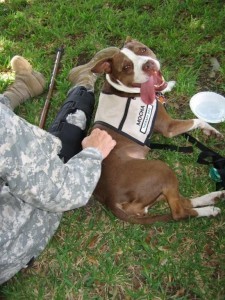
Many Pit Bull-type dogs excel in therapeutic work, with a natural love for affection and human interaction. Mocha (pictured left) was one of many.
Prior to Pit Crew’s inception, Pit Bulls like Mocha were already serving in therapy dog organizations, but they were rarely getting any acknowledgement. In fact, many people had to lie about their dog’s breed just to get in the door. Negative stereotyping plagued these dogs.
LOVE-A-BULL aims to change the perception of these dogs, bringing to light the truth about them, highlighting their versatile strengths. Pit Crew is just one branch of LOVE-A-BULL that does this. We do not claim that all Pit Bulls excel in therapy work. Only 1% of all dogs have the temperament to work in this field. We simply want to give credit where credit is due, pointing out that a large percentage of those dogs are, in fact, Pit Bulls and Pit mixes. By facilitating a program that allows social, well-trained Pit Bulls to shine, Pit Crew is the proof in the pudding, so to speak. And we do it all while giving back to the community, working with children, the elderly, and anyone else who can benefit from the company of a sweet, loving dog.
The Pit Crew program replaces negative stereotypes with positive first-hand experiences. We are re-opening minds and hearts to the good side of Pit Bulls -dogs that the U.S. once proudly touted as “America’s dog.”
To read more about the history of the Pit Bull in America, we strongly recommend Bronwen Dickey’s enlightening book: Pit Bull – The Battle Over An American Icon.
When did it all start?
LOVE-A-BULL launched its first Pit Crew training program on February 26, 2011.
Was it difficult to get everything going?
Yes. Pit Crew is the first program of its kind and was an ambitious undertaking in a world all too quick to condemn these dogs. From insurance, to training, to marketing the program; everything had to be built from scratch. As a non-profit, all resources for the Pit Crew are donated, including our training space, trainer’s time, coordinator’s time, and our precious teams’ time. We are still 100% donation and volunteer run!
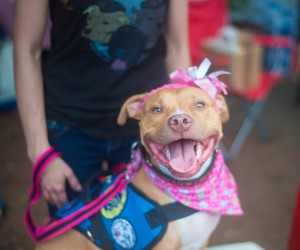
Possibly the most difficult challenge was overcoming the fear. At first we had to convince people to let us volunteer our dogs at their establishments. Even after meeting our dogs in interviews, we’d hear things like: “can we dress the dogs up in hats?” The concern was never for how our dogs would perform, but for what people might think when they heard they were pit bulls. We refused to play into these stereotypes. Our dogs are pit bulls and proud of it. And it hasn’t taken people long to see why.
Pit Crew has garnered such love and popularity in the community that they’ve won an award of excellence from Austin ISD, and been nominated for awards from Hope Alliance. They are in such high demand that we can’t fulfill all of the requests. We are always actively recruiting therapy teams. And while some of our dogs like to wear hats and tutus, these things are never required. Our dogs are awesome just the way they are!
Why do Pit Bulls make good therapy dogs?
A good therapy dog loves people, is trainable, is sensitive to human emotion, has a high tolerance for chaos and noise, is neutral to other dogs, and enjoys adventures in new places. Not all dogs possess these traits, but many pit bulls do! These traits are pretty common in Pit Bull-type dogs, as evidenced in the American Temperament Testing Society’s statistics, which place them slightly higher in temp tests than the beloved Golden Retriever.
The thing that makes our dogs unique is not their breed, but the history and stories that they can share. All of the Pit Crew dogs are rescues. They’ve overcome challenges and often been victim to stereotyping and bullying that many people can relate to. Yet Pit Crew dogs harbor no ill-will toward anyone. They have truly overcome challenges with kindness, and can serve as wonderful examples of how the best way to triumph over hate, is to love.
How old does a dog have to be to join Pit Crew?
All Pit Crew dogs are at least 2 years old.
Is there a minimum age for handlers?
Handlers must be at least 18 years or older.
What are the requirements to join?
Our dogs must be…
- Recognizable as a “Pit Bull” or “Pit Bull mix.” This is a very broad description and is very much in line with our message: pitties come in a variety of shapes, colors, and sizes!
- Canine Good Citizen (CGC) certified: Available at many training facilities, this is the AKC’s standard test for evaluating baseline obedience and temperament skills. It shows that the dog has received foundation training, and that considerable effort has been made by the handler to achieve sound, reliable behavior in public spaces. If you’re worried about taking this test, our trainers are happy to help guide you.
- Spayed/Neutered
- In good health. All dogs must be up to date on vet recommended shots and receive a clean bill of health yearly from their vet (including exam and stool sample). All dogs must be free of pain or other ailments which may cause them to feel unwell during visits. The dog’s health, happiness, and well-being always comes first in our program. Always.
- Suited for the job. Therapy work is only fun and rewarding when a dog enjoys it. Some dogs love to be the life of the party, while others prefer a more peaceful environment. In the therapy dog world, the former personality type usually works better than the latter. The dog must be well-socialized, possess an outgoing yet manageable energy, and respond well to people of all types and abilities. They must behave in a predictable manner, respond well to equipment and sometimes strange looking/sounding objects, remain responsive to their handler in excitable situations, and be dog neutral. In short, they must display impeccable trust for their handler’s ability to make good decisions.
Pit Crew classes are designed to prepare dogs for the real-world of therapy work. Most dogs who join our classes are not perfect and may spend those seven weeks working on honing their skills, overcoming a hesitancy around wheel chairs, working out the kinks in leash walking around other dogs, etc. So long as no aggressive or overly fearful tendencies are present in the dog’s behavior, we are happy to work with these dogs to see how they may become more confident and trusting. At the end of the day though, the dog’s personality is the key. If the dog loves the work and trusts their handler, they will usually excel in class. Those who don’t pass still stand to learn a lot from this training and usually move on to dog sports or other fun activities.
What kind of training do the dogs go through?
Most Pit Crew dogs start out in obedience classes like any other dog. They learn their basics, proceed to more 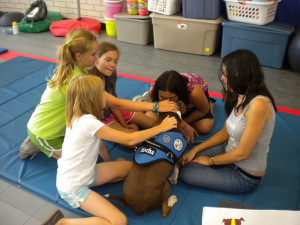 advanced levels, and eventually qualify for their Canine Good Citizen certification. The Pit Crew training class is the last leg of their therapy dog journey, and provides instruction on how to use what they’ve already learned while preparing them for the environments they will be expected to work in. Much of this is teaching the dogs and humans how to excel in potentially chaotic situations. Our handlers learn how to read their dog’s body language, set them up to succeed, and communicate with the people they visit. It’s more than just dog training, it’s people training, and our handlers have a vested interest in knowing their dogs on a deeper level. Pit Crew classes run for 7 weeks and end in a certification test that includes temperament testing, obedience testing, and a written portion that covers our training manual. Our standards exceed the national standards for therapy dogs.
Where does the Pit Crew visit?
Check out our list of places. You’ll find news segments, articles, and pictures of us in action!
Do any rescue dogs belong to Pit Crew?
Yes! All of the dogs in the Pit Crew were rescued.
Can Pit mixes join?
Yes!
Do the dogs visit places in a group or singly?
There are opportunities for both group activities and individual participation.
About how many visits are done a month by all of the dogs?
The frequency of activities is determined by the needs of the facility and our team’s availability. On average we offer 3-5 volunteer opportunities a month, with more during our peak season (Sept-Nov).
Are people always receptive to the program?
Most of the time! While it wasn’t so easy at first, perceptions about Pit Bulls are changing. Despite stereotyping, the Pit Bull has only gained popularity and is one of the most common family dogs in America. It’s hard to avoid harrowing stories about loyal Pit Bulls saving family members in fires, serving as police dogs, or helping people as service dogs. They are one of the most common dogs sought after for PTSD service work. Most people have already met a sweet Pit Bull, and many have one at home.
In other words, people are learning. When people are fearful or nervous about our dogs, we simply respect their space and right to be afraid. No one is ever forced to interact with our dogs. It is purely voluntary and 100% positive. Part of our training includes an education on how to talk to people about the facts surrounding this breed, how to respectfully speak to people about their fears, and how to represent your dog as an individual.
Do you encounter fear or hesitation because of the stigma attached to the breed?
Sometimes, but we view this as an opportunity to have a great conversation if the person is willing. Positive experiences with Pit Crew have helped many people talk about their fears. We’ve met people who have only had great experiences with Pit Bulls, as well as those who have had negative ones. Our purpose is to listen and let our dogs do their job. At the end of the day, our dogs pose no threat and are only there to help. It does not discount the harm done by another dog, nor is it related.
Is Breed Discriminatory Legislation (BDL) a problem in Austin, TX?
Austin is a very open-minded community when it comes to animal welfare issues, but there is still a very real possibility of breed-specific restrictions rearing their ugly head when it comes to the Texas legislature. Also referred to as BSL (Breed Specific Legislation), it is always a threat that looms over Pit Bull owners, not only in Texas but all over the country (and in other countries, as well). Every day, we must do our part to promote responsible Pit Bull guardianship in a shared effort to make BDL/BSL a thing of the past.
What about the surrounding areas?
Yes, other towns and cities in Texas have encountered proposed breed-specific legislation. While it is currently illegal in the state, that restriction is not always respected. This is why Pit Crew is part of a bigger organization, LOVE-A-BULL, that can help people with these matters. We provide assistance and information to other communities (in Texas and beyond) to fight BDL and to encourage lawmakers to focus on strengthening enforcement of existing laws, giving owners access to support and resources, and to think about ways to improve public safety through non-breed-specific means. Check out the other programs and resources on our site if you need help battling BDL/BSL.
Any advice for someone who wants to try something similar?
LOVE-A-BULL operates with a basic attitude of “let’s be brave and try it!” Many of our initiatives started as a simple idea, followed by the question, “why not?”
Pro-Pit Bull programs in many communities are rare, but we hope that we can serve as an example of how they can work and become assets to the community.
We decided to fill a void in terms of positive education and outreach about dogs who were being bullied and abused. We didn’t have a lot of money, and we had tons of people working against us. Yet here we are. I took guts, energy, time, and commitment in the face of unwelcoming odds. But we are proof that education, outreach, rescue, and even an entire therapy dog program can succeed in improving the lives of people and their Pit Bulls. With a little tenacity, great things can happen.
We encourage others to plant a seed of an idea, give it some nutrients via time and effort, garner support, consult those who may have done it first, and grow. Do it for the right reasons and make it work. Dedication is at the core of our mission. If you have any questions about how we started our program and what running it entails, we are happy to share.
What are some of the reasons people love Pit Bulls?
The reasons that people love pit bulls are as varied as you can imagine. Some swear that that they are the sweetest of all dogs, although we have heard similar claims about other breeds. Others proclaim that they are the funniest. Then there’s their athleticism and boundless energy that wins them sporting titles and competitions, placing them at the top of many dog sports. Yet we’ve known some seriously lazy couch potato Pit Bulls too. Others claim that they are the smartest and most sensitive of all dogs, but we aren’t aware of any tests that prove this theory. Protective and loyal also fall into the mix, but we could say that about a lot of dogs, right?
What you love about the breed may simply depend on the individual dog. Possibly the most lovable thing about Pit Bulls is the variety in which they come. From energetic to lazy, outgoing to shy, they can be vastly different from each other. They vary even in size, from thirty pounds to eighty and up. Their colors and patterns are as limitless as their personalities!
Whatever their magnetic appeal is, we can only describe it as the magic of dogs. Pit bulls are just dogs, after all. Chances are, no matter what you’re looking for in a dog personality, there is a Pit Bull out there that would make a great friend and partner for you. We urge you to give them a chance.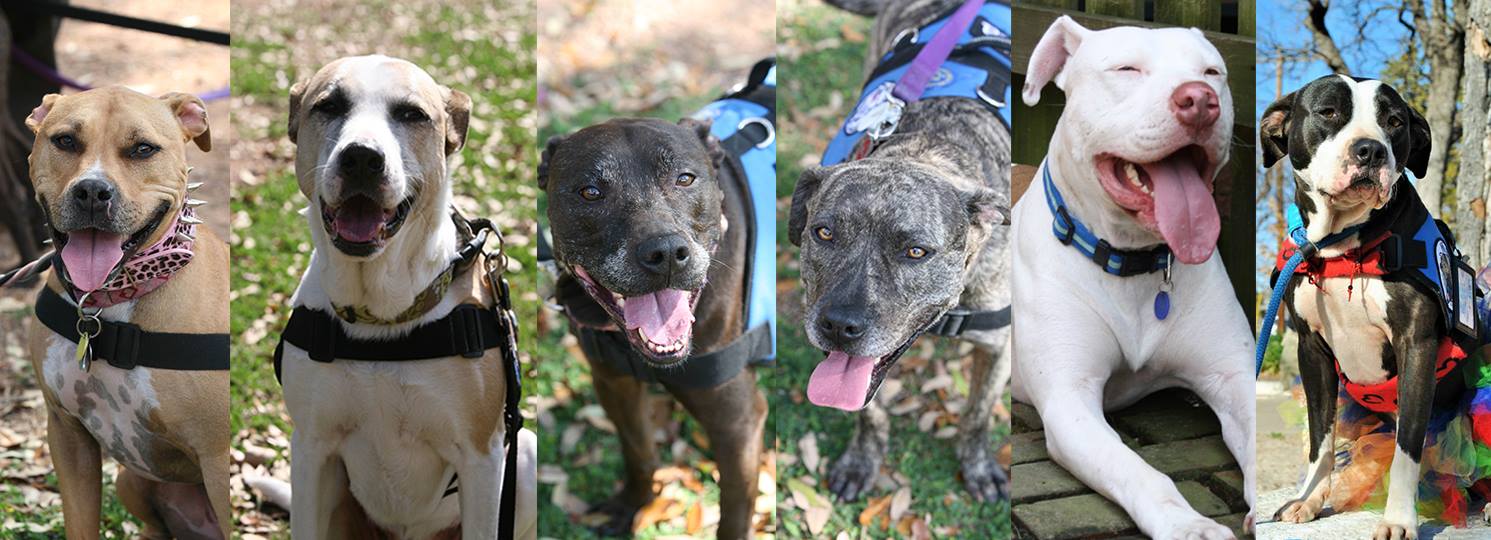
Where can we follow progress on the Pit Crew and learn more?
LOVE-A-BULL maintains information on the Pit Crew program on its website, at
www.love-a-bull.org/programs/the-pit-crew, and also on our Facebook page.
For more information about Pit Crew, click here to send us a message!